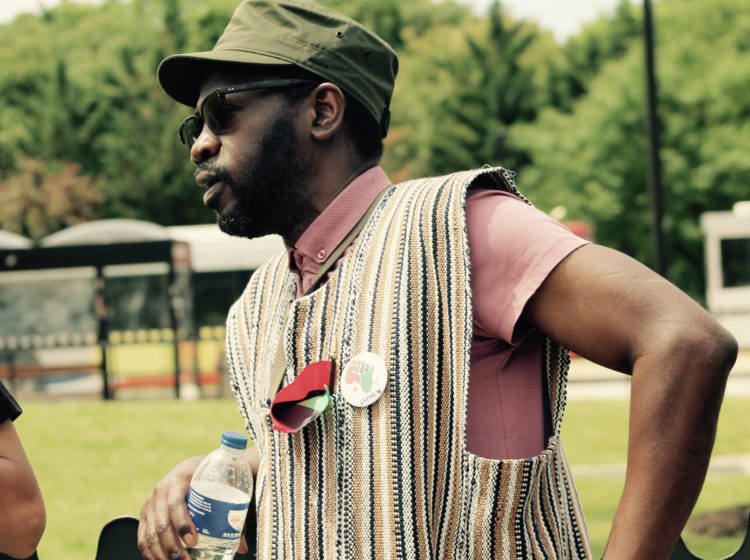
Omali Yeshitela

Biography

AFRICAN REVOLUTIONARY • POLITICAL THEORETICIAN POWERFUL SPEAKER • "LAST MAN STANDING"

“You have the emergence in human society of
this thing called the State.
What is the State?
The State is organized bureaucracy.
It is the police department…the Army, the Navy
It is the prison system, the courts.
The State is a repressive organization.
The reality is
the State becomes necessary
only at that juncture in human society
where it is split between those who have and those who ain't got!”

From “Police State,” on let’s get free! by Dead Prez

Fiery, uncompromising and courageous as the leader of the movement for a liberated Africa, Omali Yeshitela has struggled for black freedom for 40 years.

Leader of the Uhuru Movement, and Chairman and founder of the African People’s Socialist Party, Yeshitela continues to be on the frontlines of struggle, building African-worker controlled institutions, developing ground-breaking political theory, writing countless books and articles, speaking worldwide, fighting for reparations, galvanizing allies, influencing the popular culture and bringing African people together to liberate Africa and all its resources.

Omali Yeshitela has faced arrests, trials, imprisonment and personal sacrifice in his struggle to complete the Black Revolution of the Sixties. Chairman Omali never stopped building fighting organizations in the interests of the African working community. He survived the U.S. government's attack on the Black Power Movement of the 1960s that imprisoned, assassinated or silenced most black revolutionaries by driving them underground. For this he has been called "the last man standing.

Omali Yeshitela

  • Built the African Socialist International, an organization made up of African people in Africa, the U.S., the Caribbean and around the world to liberate and unite Africa and all its resources as the birthright of African working people everywhere. Its founding congress is scheduled for March 2008 in West Africa.
  • Made reparations for African people a household word after he launched the first International Tribunal on Reparations for African People in New York in 1982. The Tribunal ruled that African people are owed $4.1 trillion in reparations for stolen labor alone. Twelve subsequent sessions of the tribunal have been held in various cities around the country. The latest session of the Tribunal will be held in Berlin, Germany in June 2007.

Campaigns and organizations:

  • Freed Dessie Woods, sentenced to 22 years for defending herself against a white man who tried to rape her in 1975.
  • African National Prison Organization, 1980.
  • African National Reparations Organization, 1982.
  • Measure O, the bold Community Control of Housing Initiative that won 22 percent of the vote in Oakland, CA in 1984.
  • Acquitted in 1990 when brought to trial for defending African youth being harassed by the police;
  • International People's Democratic Uhuru Movement in 1991 to defend the democratic rights of the African community.
  • Led the community fight back after the police murder of 18 year old TyRon Lewis and the subsequent police attack on the Uhuru House in 1996. The Clinton administration was forced to send in his HUD chief and hold hearings by the Human Rights Commission.
  • Ran for mayor of St. Petersburg in 2001, winning all the black and mixed precincts but one.
  • Built the Florida Alliance for Peace and Social Justice in 2001, the only African-led anti-war organization.

Built African working class-led institutions and businesses:

  • Umoja restaurant, St. Petersburg FL, 1970s
  • African Connection Bookstore, Louisville, KY, 1980
  • Florida Black Voice newspaper, Gainesville, FL, 1981
  • Spear Graphics printing, Oakland CA, 1980s
  • Uhuru Bakery Café, Oakland CA, 1987
  • Uhuru Furniture Stores, Oakland, Philadelphia and St. Petersburg, since 1989
  • Uhuru Foods concessions and catering, since 1987
  • Uhuru holiday pies since 1981

Developed groundbreaking political theory:

  • African Internationalism, Yeshitela’s political theory that proves that capitalism is parasitic, built on the enslavement, genocide and theft of the land, labor and resources of African and oppressed peoples.
  • Proved that the whole white population sits on the pedestal of the oppression of African and other peoples.
  • Analyzed that the U.S. government’s defeat of the Black Revolution of the 60s, along with the imposition of drugs into the African community, mass imprisonment of African people and police violence in the African community are part of the counterinsurgency against African people carried out by public policies of police containment.
  • Proved that all black people wherever they are located around the world are African people and that Africa and all its resources are the birthright of African people everywhere.

Books and Publications:

  • The Burning Spear newspaper, 1968-present
  • "Tactics and Strategy for Black Liberation," pamphlet 1978
  • The Struggle for Bread, Peace and Black Power, 1981
  • Stolen Black Labor, 1982
  • Reparations Now!, 1983
  • A New Beginning, 1984
  • Not One Step Backwards, 1984
  • The Road to Socialism is Painted Black, 1987
  • The Politics of Black Revolution, first published 1989
  • Izwe Lethu I Afrika, 1992
  • "Why I Became a Revolutionary," pamphlet, 1998
  • Omali Yeshitela Speaks, 2005
  • One Africa! One Nation!, 2006

Publications

One Africa! One Nation!
The African Socialist International and the movement
to unite and liberate Africa and African people worldwide
(July 2006, 382 pages)

A historic collection of presentations explaining why Africa and all its resources must be liberated and in the hands of African workers and peasants in Africa and everywhere. This book documents the process of building the African Socialist International which is rapidly growing in countries throughout Africa, and in the U.S., the Caribbean and elsewhere around the world.


Available from Burning Spear Uhuru Publications


Omali Yeshitlea Speaks:
African Internationalism, Political Theory for our Time

(June 2005, 380 pages)

In a down-to-earth, easily understood style Yeshitela lays out the most profound concepts of his ground breaking, revolutionary theory of African Internationalism which exposes why African people are impoverished and catching hell everywhere on the planet while the white world is powerful and prosperous. Yeshitela's analysis from the point of view of the enslaved explains the nature of parasitic capitalism which is built on and maintained by slavery, genocide and colonial domination. With his vision for a positive future, the Chairman lays out his bold plan to liberate Africa and African people everywhere. With a foreword by Luwezi Kinshasa.

Available from Burning Spear Uhuru Publications


Social Justice and Economic Development for the African Community:
Why I became a Revolutionary

(1997, 28 page pamphlet)

In this concise pamphlet Chairman Yeshitela gives an autobiographical account of how he came to the conclusion that he must dedicate his life to the struggle for African freedom. Written after the St. Petersburg, Florida police murder of an African teenager during a traffic stop and subsequent rebellions, Yeshitela presents concrete proposals for black community economic development as opposed to the failed policies of police containment and brutality which plagues African communities throughout the U.S. This piece appeared first as a lengthy article written by Yeshitela in the St. Petersburg Times.

Available from Burning Spear Uhuru Publications


The Dialectics of Black Revolution:
The Struggle to Defeat the Counterinsurgency in the U.S.

(1997, 39 page pamphlet)

This popular and very relevant pamphlet reveals the "dialectical relationship between our own [African] impoverishment and the wealth and well-being of white people." The Chairman's Dialectics challenges the old time-worn formula for the development of capitalism that has been put forward by the white left and exposes it as white nationalist, colonialist and incorrect. Chairman Yeshitela then documents how the African community today is the target of a U.S. government counterinsurgency war which is responsible for the police containment policies that justify the police murders and brutalization of black people.

Available from Burning Spear Uhuru Publications


More publications:

  • Izwe Lethu I Afrika, 1992
  • The Politics of Black Revolution, first published 1989
  • The Road to Socialism is Painted Black, 1987
  • Not One Step Backwards, 1984
  • A New Beginning, 1984
  • Reparations Now!, 1983
  • Stolen Black Labor, 1982
  • The Struggle for Bread, Peace and Black Power, 1981
  • "Tactics and Strategy for Black Liberation," pamphlet 1978
  • The Burning Spear newspaper, 1968-present